Financial pressure can lead to decisions people regret later |
When pressure distorts judgment, advice becomes the last line of defence
There are moments in an adviser’s career when their value is appreciated. And then there are moments when it becomes indispensable.
This is one of those moments.
2026 is not simply another difficult economic cycle. It is a year in which financial pressure is quietly, but powerfully, reshaping client behaviour. Beneath the surface of balance sheets lies something less visible, but far more vulnerable: fatigue, anxiety, shrinking reserves, and an increasing urgency to relieve pressure, often at the expense of long-term stability. This is the environment in which advisers now operate. It is precisely in this environment that advice matters most.
The real danger of financial strain is not only what it does to a client’s cash flow, but what it does to their judgment. Pressure compresses thinking. It shortens time horizons. It makes immediate relief feel rational, even when it comes at the cost of future financial security.
Clients do not experience this as irrational behaviour. They experience it as necessary. And that is where advice earns its place, not as a technical function, but as a stabilising force.
Because in moments like these, the adviser’s role is no longer confined to structuring portfolios or recommending products. It becomes the discipline of helping clients think clearly while under pressure. Of holding perspective when urgency threatens to take over. Of guiding decisions not just based on what feels right now, but on what will still be right later.
In more stable conditions, long-term thinking comes more naturally. In times of strain, that perspective narrows. Clients begin to consider reducing contributions, cancelling cover, accessing long-term savings, or cutting anything that feels non-essential. These decisions often present as logical responses, but often, they are responses to pressure, not to financial strategy.
This is where the adviser must do more than respond, they must interpret. The real work of advice lies in asking a deeper question: What is driving this decision, and what will it cost if it goes unchallenged?
Because advice, at its best, is not about facilitating decisions. It is about elevating them.
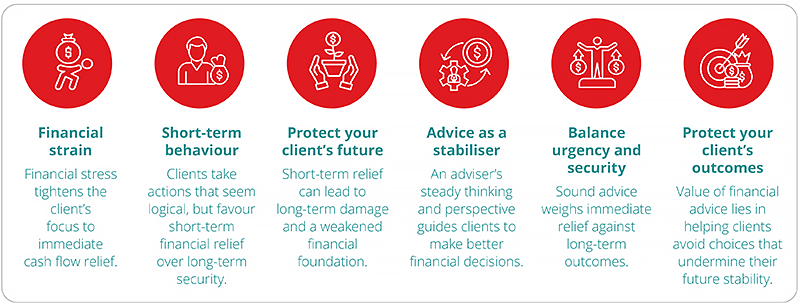
One of the most important distinctions an adviser can help a client make in this environment is the difference between what is urgent and what is important. Urgent is the expense that demands attention today. Important is the financial structure that must still hold decades from now. Urgent is the need for relief. Important is the preservation of future stability.
Sound advice does not ignore urgency, but it does not surrender to it either. It helps clients navigate present pressure without dismantling the very structures designed to protect them.
In practice, this often requires difficult conversations. Encouraging a client to reduce contributions rather than stop them entirely. Defending risk cover when it feels like an easy place to cut. Reminding clients that insurability is not guaranteed, and that decisions made under pressure can carry lasting consequences. It requires helping clients prioritise clearly understanding what must be protected, what can be adjusted, and what should never be compromised out of fear.
This leads to one of the most important reframes for the advice profession in 2026: progress will not always look like growth.
It may look like preservation.
It may look like restraint.
It may look like holding the line.
Keeping cover in force. Staying invested. Maintaining contributions, even at a reduced level. Avoiding decisions that quietly weaken a client’s financial future. In this environment, that is progress.
Some of the most valuable advice an adviser will give will not always be advice that accelerates wealth, but advice that prevents irreversible damage. Advice that protects a future that is under pressure. This kind of advice is rarely dramatic. It does not always produce visible short-term results. But it is deeply significant, because at its core, advice is not about activity. It is about protection. It is about preserving possibility when it is most at risk.
This is where the human quality of advice becomes indispensable.
The advisers who will matter most in this economy will be those who combine technical excellence with emotional steadiness. Those who can sit with clients in uncertainty acknowledge the pressure without amplifying it and still anchor decisions in long-term thinking.
This is the evolution of advice.
From product expertise to behavioural guidance.
From implementation to interpretation.
From transaction to stewardship.
And it is precisely this evolution that brings into focus a critical question for the profession: how is this level of advice valued?
Because what is being delivered here is not a product. It is not a once-off recommendation. It is an ongoing, disciplined process of protecting client outcomes, often at the exact moment those outcomes are most at risk.
It is the work of helping clients avoid decisions they cannot easily recover from. It is, in every sense, advice in its highest form. That is why advisers must begin to think more deliberately about how their value is structured and sustained within their practices.
Implementing an advice fee is not simply a commercial decision. It is a professional one. It recognises that the true value of advice lies not only in moments of growth, but in moments of protection. Not only in building wealth, but in safeguarding it. Not only in opportunity, but in restraint. It enables advisers to show up consistently, to engage deeply, and to guide clients through complexity without being anchored to product-driven interactions.
The practices that recognise, structure, and communicate that value clearly will be the ones that remain relevant, not just in times of growth, but in times of pressure.
The clearest message for advisers in 2026:
Your value lies not only in what you help clients build, but in what you help them protect when uncertainty tempts them to abandon the very plans meant to secure their future.
Regards
Sonja Steyn CFP®
Strategic Head: Wealth Management, Financial Planning & Advice: Momentum Advice