The future of advice is about outcomes, not products |
Why COFI will change the adviser's value proposition
COFI is not simply asking advisers to document advice differently. It is asking the profession to prove that clients are better off because advice happened.
There is one question every financial adviser should ask before regulation asks it for us:
If the product disappeared from the conversation, would the client still understand the value of your advice?
For too long, advice has often been judged by what appeared at the end of the process: an investment, a retirement annuity, risk cover, an estate-planning structure, an offshore solution, or a platform recommendation. The product became the proof that advice had happened. But the future of advice will not be measured by what was sold. It will be measured by what changed: what the client understood, whether the recommendation was suitable, whether a better decision was made and whether the client remained on course as life changed.
That is why COFI should not be treated as another compliance event. It is a professional inflection point. It moves the centre of gravity from "Did I disclose?" to "Did the client understand?" From "Was the advice record completed?" to "Was the advice appropriate and in the client's interests?" From "Did I service the product?" to "Did I continue to serve the client's financial life?" This is not a change to paperwork. It is a challenge to the way we define, deliver, and defend the value of advice.
When the product becomes the proposition
Product-led advice is not necessarily poor advice. Products remain essential tools for solving real client needs. The problem begins when the tool becomes the proposition. A client may leave knowing what they bought, but not why it matters. They may know the premium, but not the trade-off. They may know the fund selected, but not the behaviour required to remain invested. They may know the policy benefits, but not the risks still left uncovered. They may know their projected retirement value, but not the decisions required to make it achievable.
That is where the adviser's value becomes dangerously compressed. If clients believe our value lies in product access, then technology, direct platforms, comparison tools, and price-led competitors will continue to weaken our position. But when clients understand that our value lies in professional judgement, interpretation, prioritisation, behavioural coaching and ongoing accountability, the role of the adviser becomes stronger, not weaker.
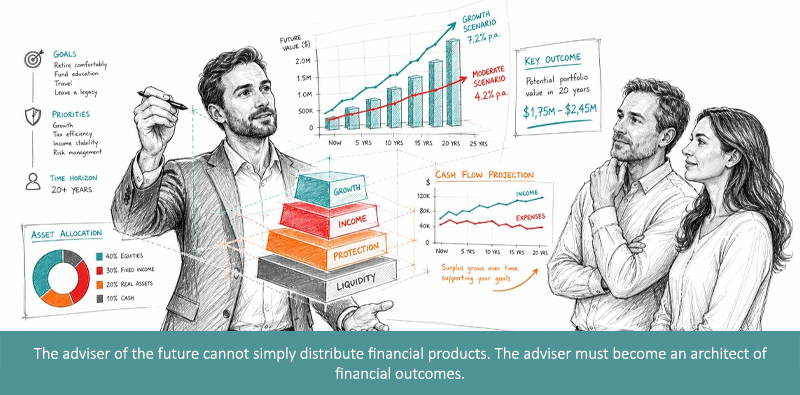
Outcomes advice is harder advice
Outcomes-based advice is sometimes mistaken for softer or less technical advice. In reality, it demands greater discipline.
- It requires the adviser to understand the client's full context: goals, obligations, dependants, debt, tax position, estate-planning gaps, retirement readiness, liquidity needs, risk exposures, behaviour, and financial confidence.
- It requires prioritisation: clients cannot always address every need immediately. Good advice therefore helps them understand what matters most, what must happen first and which trade-offs they are making.
- It requires clarity: atechnically correct recommendation that the client does not understand is not a successful advice outcome. If clients cannot explain the decision in their own words, we should question whether the advice has truly landed.
Most importantly, it requires the adviser to remain present after implementation. Outcomes do not happen at the point of sale. They develop over time, while markets, legislation, employment, family structures, health, and priorities change. Advice that is not reviewed becomes stale. Stale advice becomes conduct risk.
How adviser engagement must change
The future advice conversation should not begin with a product category. It should begin with the client's life. The adviser must first understand where the client is, what they are trying to achieve, what may prevent them from getting there and how they make financial decisions. This demands more than data capture. It requires discovery that reveals the client's goals, pressures, obligations, risks, and level of confidence.
The client should then be guided to the right advice pathway based on need, complexity, urgency, vulnerability, licensing, and adviser competence. Some clients may need education and focused guidance. Others may require comprehensive planning, specialist advice, or a coordinated journey across several professional capabilities.
The adviser must translate analysis into a clear decision framework. The client should understand what matters most, which options exist, what the trade-offs are, what may happen if no action is taken and why the recommended course is appropriate. The engagement should conclude not only with implementation, but with agreement on the outcomes being pursued, the actions required and the review rhythm through which progress will be assessed. That is the difference between completing a transaction and establishing an advice relationship.
From adviser intent to an advice operating model
COFI will test the substance behind the process. A complete file does not prove that the client understood the advice. A signature does not prove that the recommendation was suitable. A completed review does not prove that the client's changing circumstances were meaningfully reconsidered. The real test is whether the advice process consistently produces fair, suitable, and understandable outcomes.
That cannot depend on adviser intent alone. Firms must build an operating model that makes client-centred advice practical, consistent, and repeatable. This means clearer advice pathways, stronger discovery and analysis tools, defined adviser mandates, effective referral points, consistent advice standards, meaningful review processes, and quality assurance that tests the substance of advice rather than the presence of documents.
It also means better management information. The future advice business will not ask only, "How many clients did we see?" It will ask: How many clients understand their financial position? How many have an updated plan? How many know whether they are on track? How many acted on the advice? How many are better positioned because we were involved?
Those are the questions that will separate advice businesses from distribution businesses.
The proposition must change
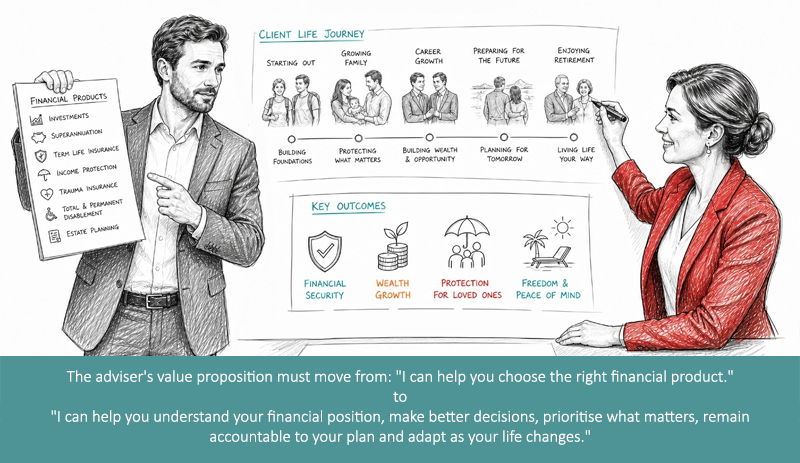
Clients do not only need information. They need interpretation. They do not only need access. They need guidance. They do not only need choice. They need prioritisation. They do not only need a financial plan once. They need a financial-planning process that moves with them.
The intended end state is a connected advice experience in which every client is guided to the appropriate capability, receives advice aligned to their circumstances and understands the plan, the priorities, the actions, and the outcomes being pursued. Products will remain important, but they will no longer define the proposition. They will be tools used to achieve agreed outcomes.
Our proposition should therefore be clear:
We help clients understand their financial position, make informed decisions, prioritise what matters and remain accountable to a plan that adapts as their lives change. Through professional advice, appropriate solutions, and ongoing guidance, we help clients achieve better and more sustainable financial outcomes.
COFI is not the threat. Irrelevance is.
It would be easy to respond to COFI defensively: more complexity, more oversight, more cost and more administration. But that would miss the larger point. The real threat to advisers is not regulation. It is irrelevance in a world where clients have more information, more digital tools, more product access, and more financial noise than ever before.
COFI simply accelerates a question the profession should already be asking: Are we truly delivering advice, or are we still relying on products to prove our value?
For advisers who define their role through product implementation, the shift may feel uncomfortable. For advisers who see themselves as professional, relational, and outcomes-driven, it is an opportunity to become more relevant, not less. The profession has long argued that advice creates value. The next chapter will require us to evidence it. Not through longer documents. Not through more complicated terminology. Not through product comparison alone. But through better understanding, better decisions, better financial behaviour, and better long-term outcomes.
When advice is no longer defined by the product sold, it can finally be recognised for what it should always have been: a professional discipline that helps people make confident, informed, and responsible financial decisions through the most important moments of their lives.